

Interview
In Conversation with Sim Chi Yin
This written exchange between the curator (OPK) and artist (SCY) took place in July 2025.
Ong Puay Khim [OPK]: Remnants , presented in this exhibition, is part of your long-term, ongoing project, One Day We’ll Understand . Could you share what led you to embark on them?
Sim Chi Yin [SCY]: One Day We’ll Understand is a multi-chapter, multidisciplinary project that encompasses photographic and filmic installations, glass works, books and a theatre performance. Remnants is one of the chapters. The whole project started in 2011, and stems from family history.
I started wondering why my paternal grandfather was a ghost figure in the family—there were no photographs of him in the house; no one ever spoke about him. Eventually I reconnected with my relatives in China and found my way back to our ancestral village in China (Gaoshang village, Songkou town, Meixian county, Guangdong province) in early 2011. There, I was greeted by a three-metre obelisk memorialising my grandfather. I was floored by the disjunct: In the Chinese village, he was memorialised as a martyr of the Chinese Communist Party during the country’s civil war (which ended in October 1949). However, within his own family, he had been erased. It took a while but eventually I joined the dots: Grandad had been an anti-colonial intellectual, educator and journalist in Malaya. He was arrested and jailed by the British in the small town of Selama, Perak (north of Taiping), near the start of the Malayan Emergency in mid-1948. He was later deported (like 30,000–40,000 other Malayans who were suspected to be Leftists over the course of 1948–1960), based on ethnicity, to China. After a six-year search in multiple archives, I managed to track down his records. They showed that he was deported on a Dutch commercial vessel that left Port Klang in May 1949. He returned to our ancestral village and joined the local Communist guerilla unit of the People’s Liberation Army. He was subsequently arrested by Kuomintang (Chinese Nationalist Party) soldiers. This was his third arrest—he had also been incarcerated and waterboarded by the Japanese in Malaya. Chinese county archives show that in July 1949 he was executed by the Hu Lien army unit of the Kuomintang.
Grandad’s mother, wife and five children in Malaya did not learn of his death for another two years. I have a 1951 diary entry from his eldest son (my uncle) recounting when the letter from China arrived, informing them of their father’s passing. His mother and wife ordered the children never to speak of their father ever again, probably out of heartbreak and to keep the family from further political trouble. I explore a bit of my grandma’s lifelong trauma as an archetypal Cold War widow in my book She Never Rode That Trishaw Again . This is the first of four titles I’m attempting to make from this long project.
Remnants is one of the chapters, encompassing the two strands in the collection of Singapore Art Museum (SAM): landscape photographs of sites of memory of the anti-colonial war in Malaya and a series of still-life studies of objects from the war, specifically those that belonged to Leftists. The former were elected as a way of describing the Malayan Emergency (a term coined by the colonial government) and the postcolonial states that inherited the places.
Accompanying Remnants are the chapters Requiem —a video installation of Leftist veterans singing songs from the resistance movement—and Interventions . The latter is a series of glass plates I made arising from British photographs of the Malayan war that were collected by Britain’s Imperial War Museums (IWM) archives. The work reveals the indexicality of the colonial archive. It questions what an archive is, who gets to decide how a war is represented and remembered. The more recent chapters of the work take a speculative leap, departing from the more documentary and evidential focus of the earlier pieces.
OPK: Remnants , a small selection of which is in the collection of SAM, can be described as an alternative archive of the Malayan Emergency. How do you decide which objects and documents to examine and capture? Can you speak specifically about these still-life studies—to whom do they belong, where did you encounter them and what histories and memories do they hold?
SCY: The still-life studies of objects of war came from 40 or so oral history interviews I did with former anti-colonial fighters, activists and foot-soldiers between 2015 and 2019. They were spread out over the places where they had been deported or exiled to: Hong Kong, southern China (including Xiamen, Guangzhou, Foshan etc.), Malaysia, southern Thailand, Singapore and Beijing. I found them through word of mouth, introductions, one by one. I focused on the foot soldiers of the Malayan Leftist movement, ordinary folk who did not have the resources to write their own memoirs. We learn about these “Communist terrorists” as they are called in our national histories (both Singapore and Malaysia) and from our national monuments commemorating the triumph over the insurgency. There was brutal violence on the part of the Communists, no doubt, and several veterans spoke of that on camera. But I was interested in their motivations for joining the movement. They mostly spoke of wanting the British to leave, and less about ideology or the postcolonial political imaginary. They discussed their roles within the movement, the consequences of their participation and their views of what they did.
With each person, I did interviews first, usually hours-long, sometimes I returned for a second or third interview. And then I asked if they had objects or photographs from their time in Malaya, or from shortly after they were deported or exiled. Some of them had mementos like old photographs, ship tickets, prison photos, small-pox vaccination certificates, Malaya’s first-ever identity cards. And then I’d ask if they remembered any of the songs they sang in the movement—that led to the video work Requiem .
Over the years, as I photographed more and more objects from various veterans, I unwittingly collated what became a sort of digital counter archive of the Malayan Emergency—a collection of artefacts of war which are not housed in any archive anywhere in the world, and which represents the veterans’ stories. Most the objects from the Malayan Left, which are in the museums in Singapore, Kuala Lumpur and Britain are “trophies” captured and kept by British soldiers. There are Communist flags, red-star berets and other more personal things, but the contexts of how they ended up in museum collections and how they are shown are different from Remnants . There are even skulls of Malayan communist fighters taken back to the UK and housed in a regimental museum (anthropologist Simon Harrison writes about this in his 2012 book Dark Trophies but did not footnote which museum; I haven’t been able to track this down even with the help of the IWM). As an individual—and not an institution—I couldn’t collect the physical objects. So I did the thing I knew how to: take pictures of them.
Among the items that you have selected for this exhibition are personal mementos and military objects kept by the remaining Malayan Communist army that ended up in camps or “peace villages” in southern Thailand. I have been to three of these peace/friendship villages and photographed in the little cottage-industry display rooms or “museums” (what they refer to in Chinese as chenlie guan , or exhibition halls). Each display tells its own stories—the home-made mine sweeper, the charred British pistol (burnt after the December 1989 Hat Yai Peace Agreement was signed, which stipulated the laying down of arms by the Malayan Communist Party [MCP]), the propaganda paintings on fabric, the DIY kerosene torch and the roughly sewn ammo vest. One of the objects that I found most moving, which is not included for the exhibition, was from the Betong camp: a rough-hewn prothesis leg made of wood, metal and fabric, anything that they could find in the jungle. The Communist army heavily mined the jungles spanning northern Malaysia and southern Thailand; many of the fighters stepped on their own mines (see for example Hai Fan’s book Delicious Hunger recently published in English, translated by Jeremy Tiang) and needed prosthetic limbs and eyeballs. Regardless of whatever we make of this war, it was a jungle war of 41 years by the time it ended—one of the longest in modern history—and some individuals gave their whole lives to it. There’s also the military uniform kept by the Guangzhou-based daughter of a former MCP fighter; there’s something anthropomorphic about the folded fatigues.
There is also a small A4-sized watercolour painting by Cen Yuanzhi, whom I interviewed in Hong Kong. Cen was an art student of Liu Kang’s in Muar. He made a series of watercolours and pencil sketches while incarcerated on St John’s Island in mid-1949 while awaiting deportation from Singapore to China. The painting you have here [on display] shows St John’s Island as a deportation camp, idyllic but with barbed-wire fencing and a watch tower. He has other sketches of the inmates playing guitar and singing together, as well as pencil portraits of other detainees, Malays, Indians and Chinese. The painting you have is dated 6 June 1949. Cen was deported to Guangdong only weeks after my grandfather but lived on till over 100. Cen is also one of veterans who sang Goodbye Malaya in my video work, Requiem . He even was able to come, in a wheelchair, to the opening of the first solo exhibition I did for the project, in Hong Kong, at Hanart TZ Gallery in June 2019. He took the microphone from me and sang Goodbye Malaya and other songs from their revolution, moving visitors at the opening to tears.
In making this counter archive of this war, I’m thinking of what Marianne Hirsch and Leo Spitzer call “testimonial objects.” They make the case that “material remnants can serve as testimonial objects that carry memory traces from the past and embody the process of its transmission.” Deriving from Roland Barthes’s notion of the punctum, they read testimonial objects as points of memory, “points of intersection between past and present, memory and post-memory, personal and cultural recollection.” [1]
This, in my mind, links with Pierre Nora’s notion of “Les lieux de memoire” or sites of memory, which is how I think of the landscape images I made in Remnants . [2]
Trace is central to what I was thinking of for both sets of work (landscape photographs and still-life studies) in Remnants . Both the land and objects contain traces, material and immaterial, human and non-human.
OPK: In contrast to the unembellished photographs of the still-life studies, the landscape photographs are intentionally aestheticised. While both genres present different approaches to documentation, in pairing them, do you also intent for some slippages or fluidity in meanings, and for subjectivities to seep in in how associations of memory and place are formed?
SCY: Yes, I did/do intend for the two sets of images within Remnants to be seen together. They have always been exhibited together, and always with Requiem and sometimes with Interventions and a table of texts. The artefacts/objects in Remnants were photographed almost forensically/clinically, against a white backdrop and with lights, in a sort of mobile photo studio I travelled with, from place to place, veteran to veteran. On the other hand, the landscape pictures were made deliberately to be evocative of mood, photographed at a specific time of day that I chose—usually dusk— sometimes after surveying the site, I would return to photograph the place under a specific light.
OPK: You have referred to the photographs as a “cinematic journey.” I am also curious about the form that these photographs take—the more intimately sized landscape-orientated still-life studies versus the larger square format of the landscapes—and how one might encounter a series of them at once. What were your considerations when deciding on the format of the photographs?
SCY: I intended the landscapes to be immersive and large—they are printed at over 1 metre by 1 metre. And for the objects to be smaller and more intimate as they are often people’s things. In terms of the “cinematic journey,” I was thinking more of the landscape series as taking us on a sort of road trip through the sites that bear some memory/trace from the Malayan war. The choice of the square format came organically as I started photographing the sites. I was working very slowly, often on a tripod; it was more like medium- or large-format photography, even if I was photographing 35mm digital format.
OPK: The landscapes stand as witnesses and hold material traces of the conflict, and to me, are also a form of still-life. The aesthetic approach of the landscapes offers a more evocative imagery than the objects and documents, while both allow for emotional connection. At the same time, the landscapes, in their evocative manner, open up these scenes for interpretation and imagination. It is a counter archive both in the sense of being an alternative but also as being unstable. Can you speak about the aesthetic decisions that you made when creating these landscape photographs and whether there is some level of personal interpretation of the histories that factors in the final image produced.
SCY: The landscapes are meant to conjure; they rely on imagination—mine as well as that of the viewer—and open the work up to a speculative register (which comes back in the more recent series The Suitcase Is a Little Bit Rotten in which I have used Magic Lantern slides to create an imaginary Southeast Asian landscape and a sort of time travel, and where the work starts to contemplate trans-generational memory and inheritance.)
The landscapes were mostly photographed in northern Malaysia and southern Thailand. Some of the sites in Remnants are specific sites where something had happened during the war: stretches of roads well-known for ambushes (where the Communists lay in wait for the British); tin-mining towns that were marked as “black” areas by the British, denoting that the Communists were active there (the British used “black” and “white” areas as well as the language of pestilence and disease to describe the battle against the Communists in Malaya); the jungle that was the base of the Communists, a “river of blood” where locals recalled many revenge killings by the Communists of villagers/townspeople they perceived as traitorous to their cause etc.
Some of the locations were from my research, from the literature about the war—primary and secondary literature—and others were from in-situ interviews that I did when I travelled around in the field, so for example, a field where locals recalled killings or the “river of blood.”
But I also photographed more generally based on the mood that I wanted to evoke, to create a set of landscape images that opened up the imagination—photographs of what else could be in the land, what traces that still remain, what might the non-human remember? We read from memoirs and novels of the Left that fallen comrades might have been left behind—Are there unmarked graves? Where were the helicopters that were shot down? The military installations and aboriginal villages that became submerged when the Malaysian government later enacted plans mooted by the British to build a giant dam in Grik, northern Perak, in the Belum forest, which is today a national park and lake that is four times the size of Singapore. The traces of the war and its consequences are not always visible. The landscapes in Remnants trade in what is visible but hint at what is not, in the present-absence, in the absent-presence.
One of the first images I made in the series was the blurry image of the elephant coming through the thicket of the jungle at dusk. It was in the Belum forest, the jungle that was the base of the Communists. It was my first night there, driving back from a recce of what I might photograph the next day. We ran into a family of elephants off a highway. I had that encounter with the baby elephant. There were many other frames on my camera in which the elephant is perfectly sharp, lit by the white headlights or red taillights of other cars passing by on the highway which now segments the elephants’ habitat. There was this single blurry frame—I must have moved or the elephant too. But there was something apparition-like about this elephant. On first look, it may not be apparent to the viewer what creature it is. Several people have asked me if it’s a person, a ghost. But it spoke to me about the ghosts in the land, what the non-human might remember that the human no longer wants to speak about, about the hidden histories, the undercurrents of the present. The legacies of the Malayan war are manifold and go on informing the socio-political realities of present-day Malaysia and Singapore.
I attach notes I wrote on each of these from my solo exhibition in Hong Kong in 2019, titled One Day We’ll Understand :
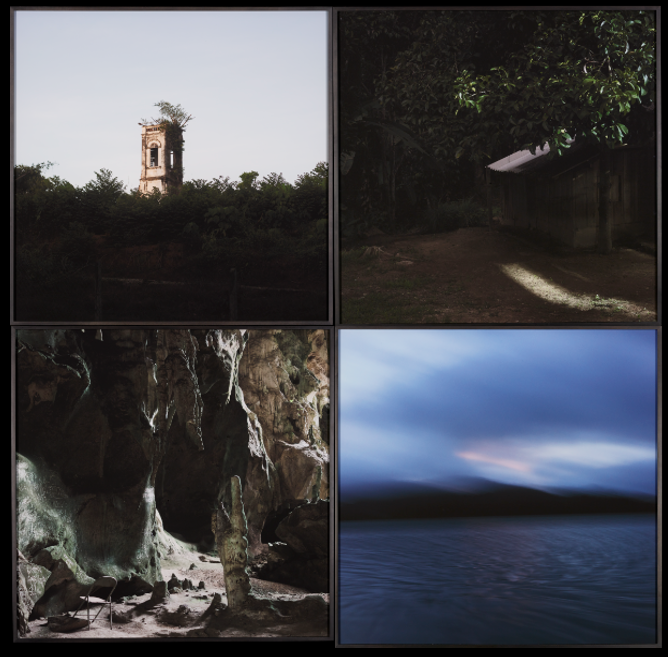
Clockwise from top left:
- Remnants #9
Church of the Sacred Heart of Jesus, Pagar Tras, Pulau Pinang, Malaysia, 2016
The “Notre-Dame of Malaya”: Built by French Catholic missionaries in 1882, its design was inspired by that of the famous Notre-Dame Cathedral of Paris. Like the 800-year-old church in Paris acclaimed for its classical Gothic architecture, the one in Malaya had two bell towers and three decorated portals on its façade. It was used by Hakka tin miners who had been converted by the French Catholic missionaries. The church became abandoned when the Hakka tin miners were moved out of the area and into resettlement camps by the British after the Emergency was declared in 1948.
- Remnants #22
Lit by moonlight, a hut in a “peace village” in southern Thailand where remnants of the MCP army settled after the December 1989 Hat Yai agreement to lay down arms and end the 41-year war. The former MCP members mostly became rubber and durian planters. Many joined the movement as teenagers from Peninsular Malaysia and have died or are today living out their final years in southern Thailand.
- Remnants #23
Sungai Siput, Perak, Malaysia, 2017
A limestone cave within a rubber estate—and the cave where Malayan communists were said to have hid before they ambushed two British planters in their office on this rubber estate and shot them at point blank. This shooting led to the declaration of a state of Emergency in June 1948 and thus began the 41-year war between the Malayan communists and the British (and then the Malaysian state).
- Remnants #13
Temenggor man-made lake, Hulu Perak, Malaysia, 2017
The British made plans to build a giant dam in the Belum-Temenggor rainforest, to flood the Communists out of their base (and to generate electricity for the local area). The plan was drafted earlier but the Malaysian government only built the dam in the early 1970s. This man-made lake and forest complex is four times the size of Singapore … Villages and military installations were drowned in the damming …
OPK: Your work combines research with storytelling, and in engaging with history, conflict, memory and extraction, ambiguities in information, meaning and value probably abound. What do you think is the role of art in addressing these issues? What are you most interested in, as an artist, when examining these related issues?
SCY: I trained in history—my first two degrees were in history and my PhD was in war studies, it was art practice-based but very historical in approach—and then went on a “truth-seeking” first career of (text) journalism and documentary photography, but am now complicating, questioning, thickening, almost pushing against those methodologies, later in life practicing as an artist. I’m deeply informed by research and my research methods span historical/academic research and artistic research, which is more associative, freer and more open. I’ve become more interested in the spaces that art can open up—in the making and in the reception of it.
I’ve also become interested in the role that art has in opening up difficult conversations around contested histories, especially in closed/semi-closed societies where political discourse is dominated by state narratives. I’ve become convinced that art sometimes is the only space available for those discussions to be had.
In thinking about trans-generational memory and inheritance too, I’m interested in the transformative potential that art has, which I’ve increasingly relied on to make sense of the past. I’ve spoken about how after a decade of working on and in the colonial archive, I’m trying to give the past somewhere to go. The methodology of artistic research and art-making is where I’m finding that space. I’ve spoken about how I’m now more interested in what’s not in the archive; those gaps, how we conjure into those gaps. I’ve described my work now as working between, against and beyond the archive(s). I attempt to cast a “disobedient gaze” [3] on the colonial archive, to interrupt its transmission of history using speculative methods of re-interpretation and “critical fabulation” [4] —engaging with imagination and its emancipatory potential as a way out of the entrapment of past.
Art engages the imagination. Its open-endedness makes space for uncertainties, ambiguities, instabilities, fallibilities, vulnerabilities and speculative possibilities. It has become a liberating force for me, it is full of potential where discussions about “facts,” “truths,” certainties and fixed readings of the past have led to dead-ends and entrenched polarisation.
Broadly speaking, in this specific project, I’m trying to use these methods to thicken, complicate and make visible other traces, readings and narratives from the Malayan Emergency. It’s a war of outsized importance in the history of warfare and counter-insurgency strategy, but its history and memory haven’t been fully reckoned with in either the former metropole or colonies. Malaya remains missing in the global memory discourse (John Akomfrah’s British Pavillion in Venice Biennale 2024 makes that pointedly clear. Refer to my reflections linked in the Resources section.)
The work uses my family history as a point of departure, is specific to Malaya’s history but also is a story that is as small and as big as you want to make it. Malaya’s story of anti-colonial resistance, its consequences and the longue durée of colonialism is one that replicates across much of the colonised world, the so-called Third World/Global South. The entanglements of Cold War, colonialism and how individuals like our grandparents were caught up in the tides of big P politics during those times are three scratches of the skin down in many of our families, if we looked. And there are many universal threads here that many might find resonances in: the stories of familial and societal silences, erasures, sacrifices, loss, hope, resilience, recovery and trans-generational inheritances. I am hopeful that even if they are unfamiliar or are not specifically interested in Malaya, viewers of the work and audience members of the performance find their own access points into the work through a piece that opens up a pathway for them, into their own histories, their own imagination.