

Interview
Conversation with Gerardo Tan
This written exchange between the curator (OPK) and artist (GT) took place in July 2025.
Ong Puay Khim (OPK): Your artistic practice has been described as engaging with issues of representation and conceptual play, and you are known for experimenting with different, unconventional materials. However, you started with painting realist landscapes and portraits when studying fine art at the University of Philippines (UP), College of Fine Arts. How has this early practice led to your interest in working across mediums, from painting, collage, photography and artists’ books to video and found objects in room-sized installations?
Gerardo Tan (GT): My early academic studies at UP dealt more with realistic painting, tackling familiar subjects like still life, landscapes, portraits and human anatomy from life. This was the curricular format for all fine arts students in the first two years before we focused on our major in our third and fourth year of training. In my third year, I had Prof. Roberto Chabet as my visual studies teacher. It was he who steered me towards experimentation and conceptual modes of art-making. Besides Chabet, I also had Prof. Ileana Lee for printmaking. Ileana’s approach to printmaking went beyond the technical. She encouraged conceptual and mixed-media processes that opened my eyes to abstraction. Both of them were instrumental in steering me towards mixed-media, process and experimental art. Outside of UP, I met Raymundo Albano who was then the director/curator of the Cultural Center of the Philippines (CCP) Museums. Ray gave me my first solo show at the CCP Hallway in 1982. This milieu affirmed my interest to work across media and extended forms of art-making using unconventional materials and processes.
OPK: Your interest in representation and how we perceive meaning in images and the world around us are evident in many of your early works. They also reveal your preference for appropriation of works by well-known artists, such as Georges Seurat’s paintings, Hiroshi Sugimoto’s photographs, Ad Reinhardt, Robert Morris and Nam June Paik, among others. Can you talk about some of these works in relation to your practice?
GT: Studying under Chabet certainly introduced us to many vanguard artists from the West, particularly from the US or the New York School. When I undertook my graduate study in SUNY Buffalo Art Dept in the early 1990s, I became aware of appropriation art, which if I recall right, was still trending then. During this time, I started doing collages using images from other artists’ works and other sources like books, gallery posters, art magazines, pieces of paper from the streets, etc. I did them in between the large works I was doing to maximize time. By appropriating images from the world of art and recontextualising them into a new work, I stripped them of their significance and gave them new meanings. In a way, I was recognising and subverting them at the same time.
Referencing or appropriating works of other artists interests me because it allows me to dialogue with other artists through their works by opening them to new possibilities. For example, when I copied Sugimoto’s photographs of theatres and turned them into large oil paintings [This is not Sugimoto’s Cinerama Dome, 2009], the “black” pigment of my palette was a combination of the six colours of the spectrum that constitute light, the medium of photography. Hence, my reversal of Sugimoto’s work happened in two ways: through its image, by turning it into a negative image; and through its medium, light becoming pigmented matter. In another instance, when I did Skateboard Drawing (2008), I was referencing Carl Andre’s idea of turning a work into a physical place that could be stepped on. This was demonstrated by the performance of the skater on top of the drawing surface.
OPK: It’s interesting how you speak of these appropriations as dialogues with the artists, responding to their processes at your own terms. Sugimoto is interested in the properties inherent to photography: tones, gradations, light, time and space, and the framing of an event. By turning his photographs into paintings, were you interested in exploring the properties of painting, not in the sense of producing an affective image, but rather in the material properties of what makes a visual image?
GT: Yes, that’s right. I am interested in the nature of painting, what it constitutes and how I can differentiate it from photography. I am also interested in creating a kind of parallelism for both media as forms of visual language.
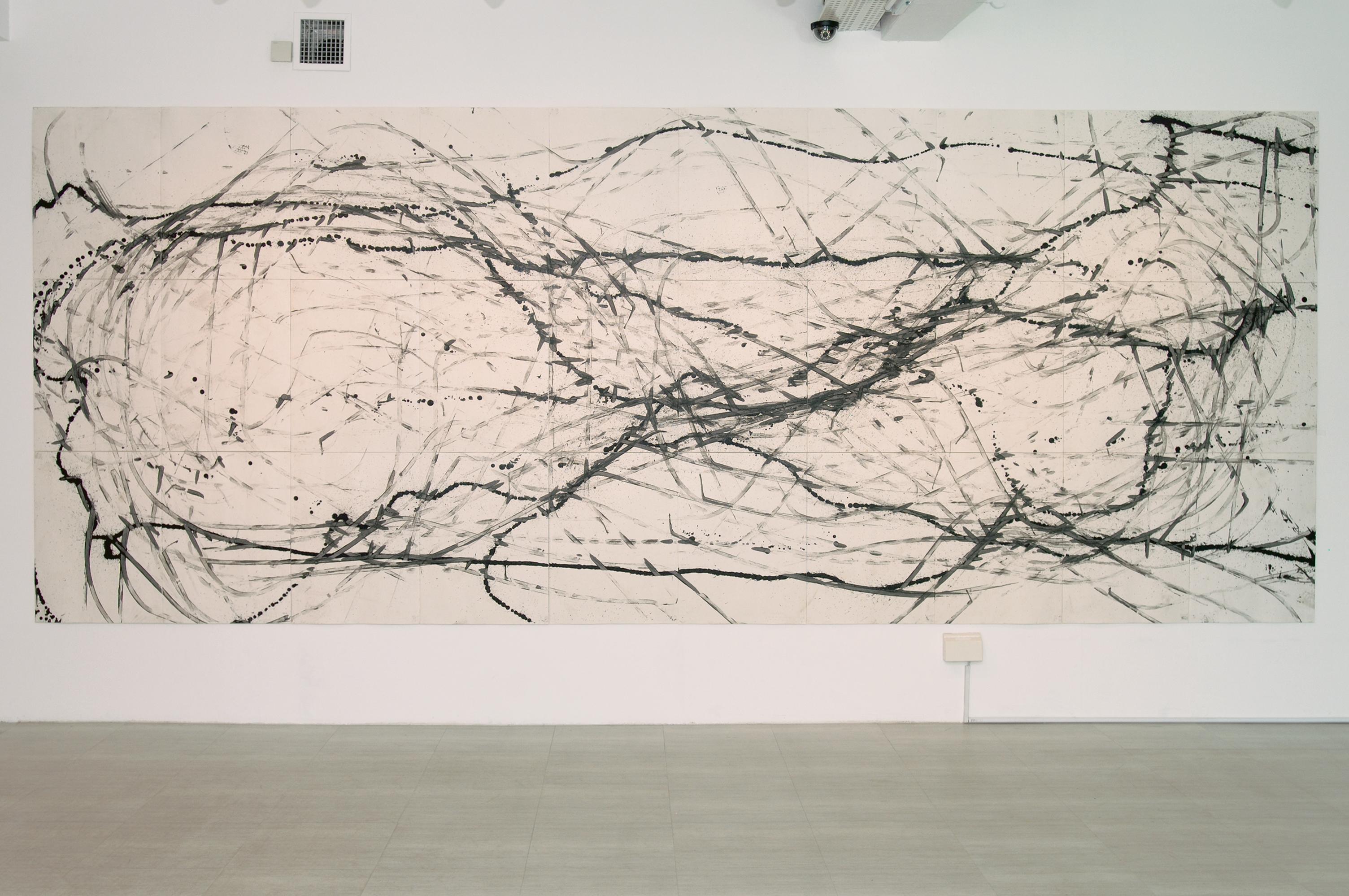
- Gerardo Tan, in collaboration with David Griggs
Skateboard Drawing 1
2008
Acrylic on paper and video
221 x 546 cm
Collection of Singapore Art Museum. Image courtesy of National Heritage Board, Singapore
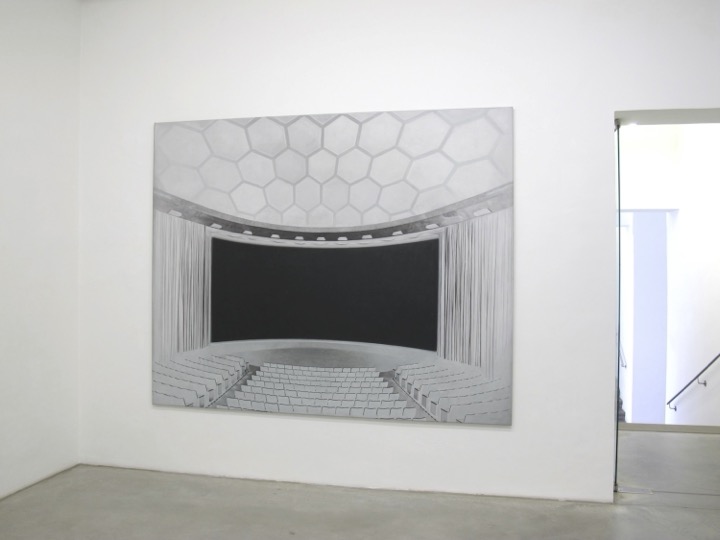
- Gerardo Tan
This is not Sugimoto's Cinerama Dome
2009 - 2010
Oil on canvas
213.4 x 274.3 cm
Image courtesy of the artist
OPK: Let us turn to your works in this exhibition, thisisthatisthis and thatisthisisthat which respectively reference Juan Luna’s Tampuhan (1895) and Canaletto’s Entrance to the Grand Canal from the Molo, Venice (c. 1737). How did the two works come about and why were these specific paintings referenced?
GT: Those two works came about by accident upon visiting a friend, the Austrian art restorer Helmut Zotter in his studio in Quezon City, Philippines. I chanced upon Helmut working on Luna’s Tampuhan and Canaletto’s Entrance to the Grand Canal from the Molo, dabbing them with wet cotton buds to extract dirt and grime from their surfaces. I then asked Helmut to collect the grime for me. About three months after, Helmut called me to pick them up.
I got interested in making works using grime from old paintings because of the sharp contrast between the tiny amount of dusty substance vis-à-vis the long history of the paintings. I thought the grime as a silent witness to the history of the painting and a physical trace of the passage of time.
OPK: I am curious about the title of the works, thisisthatisthis and thatisthisisthat, and the reasons for their specific display with a gold wall, the light fixture, a gold plate label, etc., and with the works facing each other. What led to the decision on the display format? Also, how did you decide on the form—the grime collected from Luna’s painting is framed in an ornate gold frame typical of old masters’ paintings and Canaletto’s is collected in a tiny cup.
GT: The titles thisisthatisthis and thatisthisisthat were meant to allude to the confluence of the distance between two sites or two historical points (like then and now) and my awareness of them in one moment.
The presentation format was meant to give a binary contrast between the wide expanse of the golden wall that signifies the vastness of history and cultural value vis-a-vis the tiny amount of dust with no value.
With thisisthatisthis, I was thinking back then that the tiny amount of grime from Juan Luna’s 100-year-old painting, was a form of monochrome painting, like Ad Reinhardt’s black paintings. For the tiny cup of grime from Canaletto’s painting, I was relating the form to a laboratory specimen—how culture is studied under the lens of specialised knowledge and tools.
OPK: The presentation also adopts the feel of classical museums with the light fixture and gold plate, which are part of the work, giving something as insignificant as dust the weight of history and value accumulated over time. Are you also questioning the value of art/culture, the mainstream and material versus the obscure and intangible?
GT: Yes, definitely. I am also bringing to light what constitutes value in art, noting that value is not intrinsic to material. Like dust is worthless, but if it is 100 years old and collected from the painting of a Filipino master-painter, it somehow achieves an aura of value, and real value perhaps if it is presented as art. I was also thinking back then on the works of the Arte Povera artists and their use of cheap materials, giving value to them as specific objects with conceptual underpinnings.
OPK: Another work of yours in the collection of Singapore Art Museum which uses matter that usually goes unnoticed as its primary medium is Book Project / Dust Work #4. Conceived in 2006 but completed only in 2009 to allow the accumulation of dust on pages of a book, the work comes into being not by active intervention of the artist, but by waiting and existing in time. It seems that process and an exhaustion of material possibilities, whether active or passive on the part of the artist, are important aspects of your practice. How do notions of time and history factor in your work?
GT: I consider time a significant factor in our perception of images whether we comprehend an image through the lens of daily experience of the world or through the natural forces of nature acting on it. I give equal importance to the visible and invisible factors affecting cognition and the physical condition of artworks. A lot of my works deal with process that makes time an integral element.
There were two instances when I was fascinated by the participation of time and lightness in shaping material. The first instance was noticing the feet of the Black Nazarene (the Black Christ) at the Quiapo Church in Manila. I noticed its marble feet were reduced to stumps from the gentle wiping of handkerchiefs by Catholic devotees during the annual Feast of the Black Nazarene. It was a form of slow sculpture to me— like dust collecting on a surface over a long period of time.
Another instance was seeing the deep dents on a bar table in an old restaurant in Seville, Spain. The dents were not made with forceful action but by the gentle rubbing of the drinkers’ elbows on the bar for a century or more. This reminds me of a Zen saying, on how water can corrode rock not by forceful action but by merely resting on it for a long time.
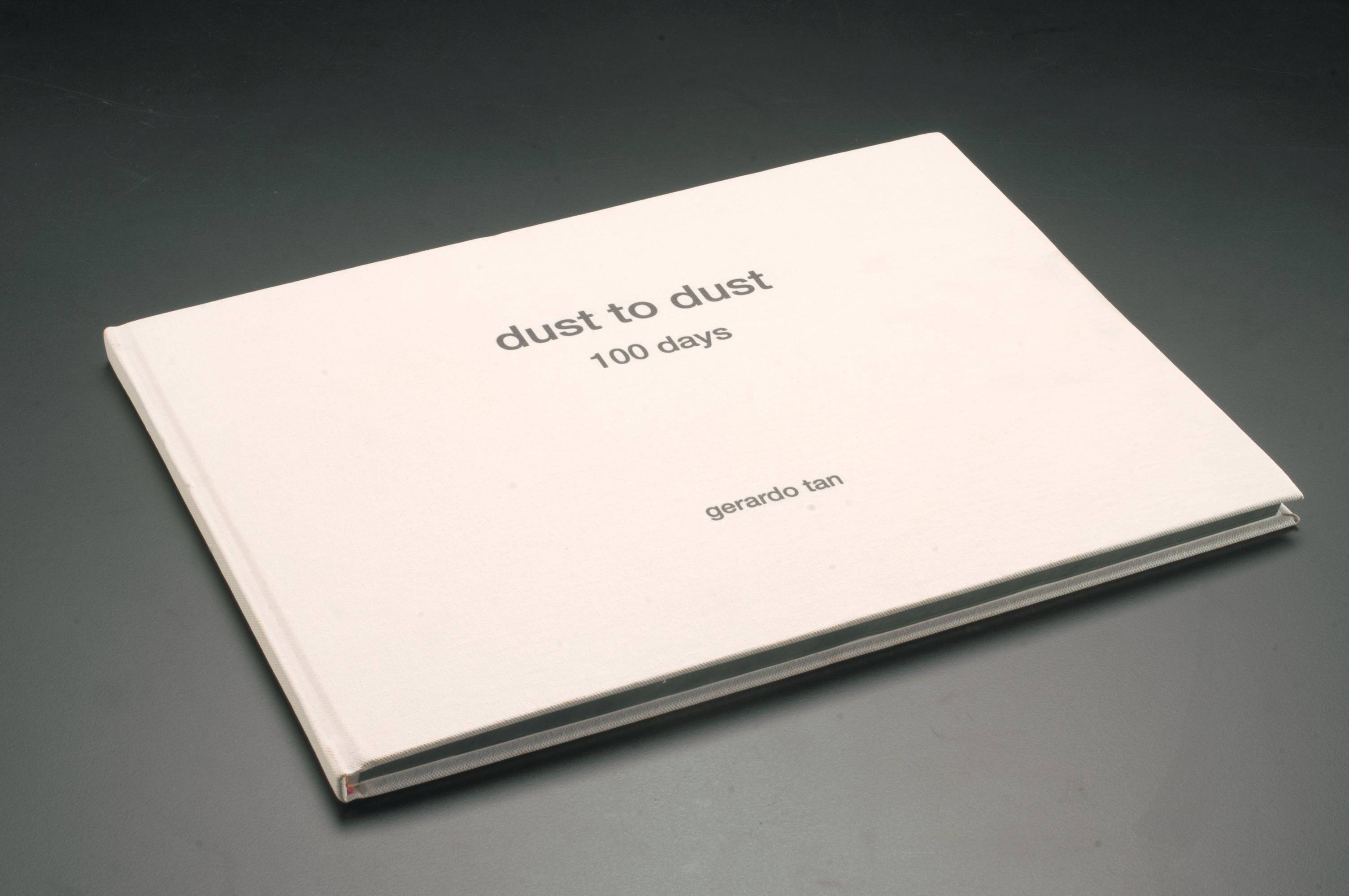
- Gerardo Tan
Book Project / Dust Work #4
2006 - 2009
Digital print on book
30.5 x 43.2 cm
Collection of Singapore Art Museum, Image courtesy of National Heritage Board, Singapore.
OPK: Letting a slowness permeate a process allows for the unfolding of time and attention. Does this approach still figure prominently in your practice now? If so, can you talk about one recent work that continues this exploration.
GT: Incidentally, Tony Godfrey is curating a show at MOSpace in Bonifacio High Street Taguig, this November 2025, and has invited me to participate in it. I will be recreating a work from 2004 called Doing Time. The work, which will be titled Doing Time Again, consists of a time clock, and red, yellow and blue time cards that correspond to the red, yellow and blue wooden poles of the work. I will ask visitors to MOSpace to clock their entry to and from the gallery space for the preceding two shows at MOSpace, using the time clock that will be installed at the entrance. The time spent by the visitors as registered in the time cards, will be converted into length (i.e., 1 minute equals 1 centimetre) and materialised as red, blue and yellow poles. These poles will be installed on the walls of the gallery space to create an immersive environment.
OPK:thisisthatisthis and thatisthisisthat were both made in 2001. How do you regard these two works today? How do they figure in your broader artistic explorations in the two decades since their making?
GT: Looking back at them, I notice their consistency with my current works in the way that the key elements of time, process, performance and self-reflexivity are materials to my work. Discovering possibilities in ordinary materials and situations is consistent in my oeuvre.
I see these two works as typical of my predilection for working with ordinary materials from daily life. This tendency connects them to each other even if they do not look alike, are made of different media and presented in different ways.